It has been brought to my notice that my post 'A Hitler Story' is fallacious. The correct story can be found here http://occoffeestop.com/Stalin_and_the_Chicken.html
Tuesday, 21 August 2018


Thursday, 16 August 2018
Is This Tantamount to Treason?
https://youtu.be/Gr_QRsZBq1o
A group of the populace whose aim is to change the Constitution of India, unfurls the party flag of the BJP and sing the national anthem of India
संविधान को बदलने की बात करने वाले राष्ट्रध्वज की जगह भाजपा का झंडा फहराकर, राष्ट्रगान गा रहे है
शेयर जरूर करे ताकि दुनिया इनकी हकीकत को जाने
A group of the populace whose aim is to change the Constitution of India, unfurls the party flag of the BJP and sing the national anthem of India
संविधान को बदलने की बात करने वाले राष्ट्रध्वज की जगह भाजपा का झंडा फहराकर, राष्ट्रगान गा रहे है
शेयर जरूर करे ताकि दुनिया इनकी हकीकत को जाने
Important Breaking news...
Our former prime minister....
The legend.....
Atal bihari ji....has passed away....
RIP
https://youtu.be/68DnBZ7hvxo
Wednesday, 15 August 2018
First Timers
I have always maintained that the present government is one of first-timers, experimentors, learners...
....and this is a small illustration
https://youtu.be/XNlsrPM8_pQ
....and this is a small illustration
https://youtu.be/XNlsrPM8_pQ
Sunday, 12 August 2018
Rice That NEEDS NO COOKING

ADVERTISEMENT
‘The rice that needs no cooking’: magic rice variety from Assam gets GI tag
From the warriors of the Ahom kingdom then to the farmers of lower Assam now, the ‘magic’ Boka saul — which recently got a GI tag — has been a breakfast staple for centuries now.
Written by Tora Agarwala | Guwahati |Updated: August 11, 2018 12:29:31 am
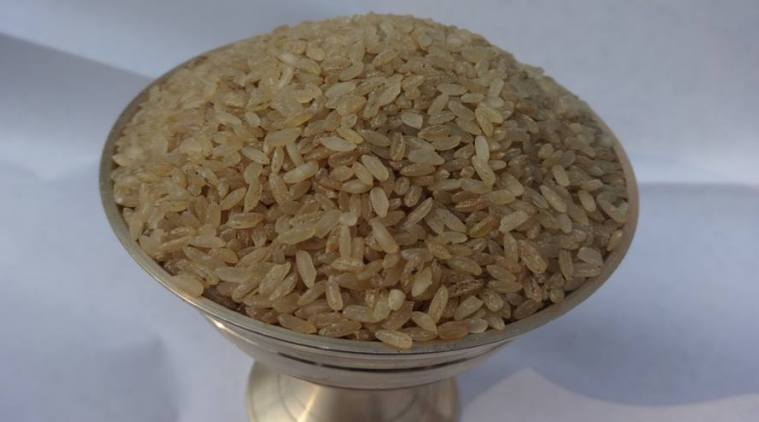
In parts of lower Assam, especially during the ‘xaali’ season (the hottest, most strenuous period of paddy farming that starts in June and ends in December), farmers subsist, almost entirely, on a specific kind of indigenous rice: boka saul, or ‘mud rice’. Those who know about this special variety of “soft” rice, swear by it. And those who do not — well, the geographical indication (GI) tag, which has just been bestowed upon it by the Government of India’ Intellectual Property India (IPI) body, should do the job.
ADVERTISEMENT
Boka saul (oryza sativa) is a paddy variety grown in parts of lower Assam — Nalbari, Barpeta, Goalpara, Kamrup, Darrang, Dhubri, Chirang, Bongaiagoan, Kokrajhar, Baksa etc. Back in the 17th century, it was the fuel for the Ahom soliders fighting the Mughal army. Today, it’s fuel for the hundreds of farmers who toil in the fields of Assam everyday, for whom it’s become a staple. The urban populace hasn’t really caught on yet. “But they should. Boka saul requires zero fuel. The rice does not need to be cooked!” says Hemanta Baishya, founder-Member of Lotus Progressive Centre, one of the two organisations who applied for the patent in 2016. “Just soak the rice in (cold) water for one hour, and it swells up like a charm. Mix it with curd, jaggery and banana, and it’s ready to eat. It will sort you for the whole day,” says Baishya, adding that the higher grade boka saul swells up in fifteen minutes flat.
ADVERTISEMENT
From 2014 onwards, Baishya’s Lotus Progressive Centre (a Nalbari-based NGO that has been working specifically for the conservation and preservation of indigenous rice varieties since 1999) along with Simanta Kalita of Centre for Environment Education (CEE), Guwahati, has been doing research and running scientific tests in order to acquire a GI tag for the rice.
“At one point, the Northeast had more than 30,000 tholua(indigenous) varieties of dhaan (grain). But sadly, due to the Green Revolution focus on the ‘mono-crop’, these have fast disappeared.” says Baishya. The agricultural practices of the Northeast are based on a system of biodiversity — “In a typical rural farming household, you will find a baari (backyard) with fruit and vegetables, a pukhuri(pond) with fish, and attached to the house, a few acres of land where the farmer sows different kinds or rice: bordhan, tengre, samraj, phul phakari, thul gaj, joha etc. He will also own a few ducks and chickens,” says Baishya, describing the scene as a perfect example of “agricultural bio-diversity” in the Northeast.
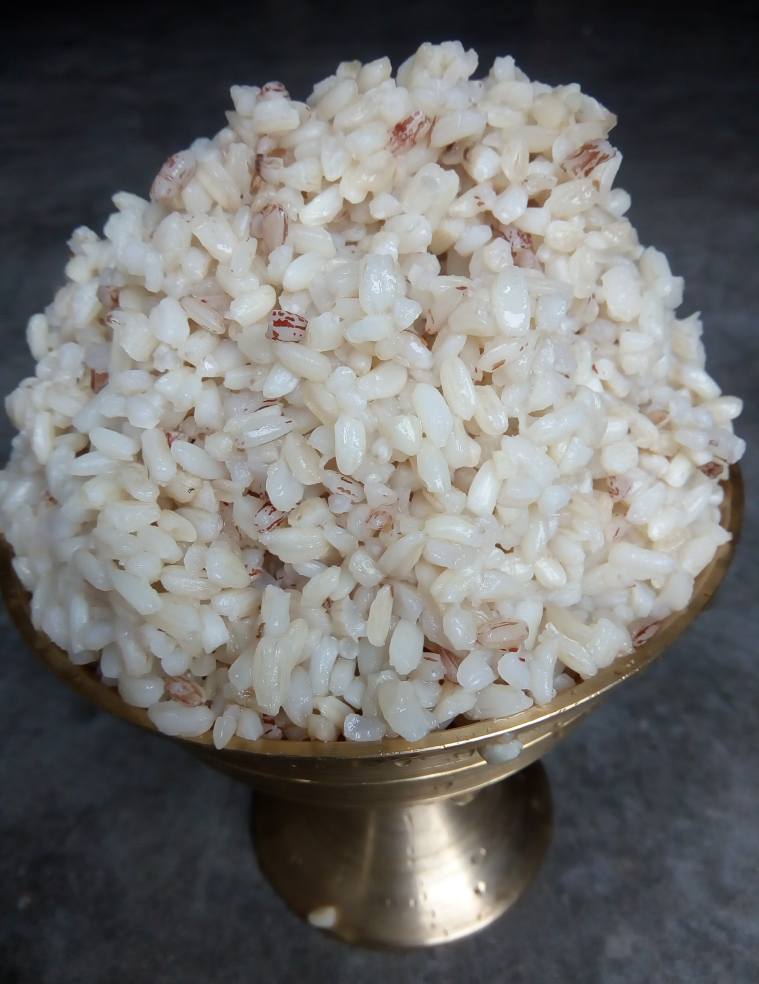 Buka saul now joins Muga Silk, Joha Rice, Tezpur Litchi — the three other products to have earned the GI-tag status. Photo Courtesy: Lotus Progressive Centre
In Assam, rice occupies a special place on dining tables, as well as festivals and other sacred ceremonies — it’s breakfast, it’s lunch and it’s dinner, too. Often, the Assamese have rice for jolpaan (the word used to denote either breakfast or tea-time) — boka saul (mud rice), kumol saul (soft rice), bora saul (sticky rice) are favourites that are mixed with jaggery, banana, curd and sometimes cream, served to guests on special occasions and eaten at home, too. “Rice is also closely entwined with our culture — we use it to welcome the groom in a wedding, we feed it to people during Bihu,” says Baishya, who did a special presentation on boka saul with CEE’s Kalita and a few farmers in a national summit by the IPI in 2017. “We had to prove the uniqueness of boka saul,” Baishya says, “We even took along some samples.” Kalita adds, “While Hemanta did most of the ground level work with the farmers, we helped at the policy level.”
While the “zero-fuel requirement” rates high on its unique quotient, boka saul — usually sowed in June and harvested in December — is highly nutritious. It has 10.73 per cent fibre content and 6.8 per cent protein, according to a study by the Guwahati University’s Biotechnology department. “It also cools down the body and is ‘default organic’. Even if you aid it with chemical fertilisers, it just will not respond — the crop will collapse!” says Baishya. Over the last four years, the scientific tests and analyses for boka saul was done in consultation with Assam Agricultural University, Indian Council of Agricultural Research, Assam Science Technology and Environment Council and Guwahati University’s Biotechnology Department. According to Kalita, the rice can work well as a “disaster management” food as well as supplement for soldiers in high-altitude frontier areas. “During floods, this is a great ‘emergency food’ for obvious reasons. Going ahead, we hope the government will consider it for its relief programs,” says Kalita, who along with his colleague Himashree, has been involved with the research from day one.
Finally, on July 30, the IPI website updated the status of GI applicants. “And we featured on it! Even though we haven’t received the physical copy of our certificate yet we have been told that it’s coming soon,” says Baishya, adding that some might confuse boka saul with kumol saul (soft rice). “The latter has similar properties but it requires warm/hot water to swell, unlike boka saul, which is receptive to cold/room temperature water. Kumol saul can come from various kinds of dhans (grains) such as bora dhan but boka saul comes specifically from the boka dhan,” says Baishya
Following the announcement, the LPC has received a lot of enquiries about the the ‘magic rice’. “The older generation is still aware but the younger lot will not be able to name even the better-known indigenous rice varieties of Assam, let alone boka saul,” says Baishya, expressing that the new status of the rice might turn things around. “Farmers, who up till now, were just growing it for themselves, will now be growing it for a wider audience. The bokarice, we hope, will then become a commercially-viable crop,” he says, “Moreover, with the ‘GI tag’, no one else in the world can claim this special rice for themselves — boka saulbelongs only to Assam.”


For all the latest North East India News, downloadIndian Express App
First Published on: August 9, 2018 4:53:29 pm
© IE Online Media Services Pvt Ltd
Saturday, 11 August 2018
Rutuja Diwekar_'s Advice To Diabetics
http://m.hindustantimes.com/health-and-fitness/nutritionist-rujuta-diwekar-on-why-you-shouldn-t-skip-rice-ghee-and-sugar/story-AYmmiMAULc1Kd7gnagcZGJ.html
*Rujuta Diwekar* is the highest paid *dietician* in India. She is the one who took care of *junior Ambani* to lose 108 kgs.
*Her advice to diabetics*:
1. *Eat fruits grown locally* ..... Banana, Grapes, Chikoo, Mangoes. All fruits have FRUCTOSE so it doesn't matter that you are eating a mango over an Apple. A Mango comes from Konkan and Apple from Kashmir. So Mango is more local to you.
*Eat all the above fruits in DIABETES as the FRUCTOSE* will eventually manage your SUGAR
2. Choose Seed oils than Veggie oils. Like choose ground nut, mustard, coconut & til. *Don't choose chakachak packing oils*, like olive, rice bran etc
*Go for kachchi ghani oils than refined oils*
3. Rujuta spends max time in her talks talking about GHEE and its benefits.
*Eat GHEE daily*. How much GHEE we should eat depends on food. Few foods need more GHEE then eat more and vice versa. Eat ample *GHEE. It REDUCES cholesterol*.
4. *Include COCONUT.* Either scraped coconut over food like poha, khandvi or chutney with idli and dosa
Coconut has *ZERO CHOLESTEROL* and it makes your WAIST SLIM
5. *Don't eat oats, cereals for breakfast*. They are packaged food and we don't need them. Also they are tasteless and boring and our day shouldn't start with boring stuff.
Breakfast should be poha, upma, idli, dosa, paratha
6. Farhaan Akhtar's New ad of biscuits - fibre in every bite... Even ghar ka kachara has fibre, likewise oats have fibre. Don't chose them for fibre. *Instead of oats, eat poha, upma, idli, dosa*
7. *No JUICES till you have teeth* in your mouth to chew veggies and fruits
8. *SUGARCANE is the real DETOX* . Drink the juice fresh or eat the SUGARCANE
9. For pcos, thyroid - do strength training and weight training and avoid all packaged food
10. *RICE - eat regular WHITE RICE. NO NEED of Brown rice.* Brown rice needs 5-6 whistles to cook and when it tires your pressure cooker, then why do you want to tire your tummy.
A white rice is hand pounded simple rice
*Rice* is not high is GI INDEX. Rice has mediun GI index and by eating it with daal / dahi / kadhi we bring its GI index further down
If we take _ghee over this daal chawal then the GI INDEX is brought further down._
*B.* Rice has some rich minerals and you can eat it even three times a day
11. How much should we eat - *eat more if you are more hungry,* let your stomach be your guide and vice versa
12. We can *eat rice and chapati together* or only rice if you wish. It depends on your hunger. *Eat RICE in ALL THREE MEALS without any fear.*
13. Food shouldn't make you scared like eating rice and ghee. *Food should make you FEEL GOOD*
14. *NEVER* look at *CALORIES*. Look at *NUTRIENTS*
15. *No bread, biscuits, cakes, pizza, pasta*
16. Ask yourself is this the food my Nani & Dadi ate? If yes then eat without fear.
17. Eat as per your season. *Eat pakoda, fafda, jalebi in monsoon*. Your hunger is as per season. Few seasons we need fried food so eat them.
18. When not to have chai - tea - don't drink tea as the first thing in morning or when you are hungry. Rest you can have it 2-3 times a day and with sugar
19. *NO GREEN tea please.* No green, yellow, purple, blue tea.
20. Eat *ALL* of your *TRADITIONAL* foods.
21. Strictly *NO* to packaged foods / drinks.
22. *Exercise / Walk*
to digest & stay healthy.
http://m.hindustantimes.com/health-and-fitness/nutritionist-rujuta-diwekar-on-why-you-shouldn-t-skip-rice-ghee-and-sugar/story-AYmmiMAULc1Kd7gnagcZGJ.html
Forwarded as recei
Subscribe to:
Comments (Atom)


